























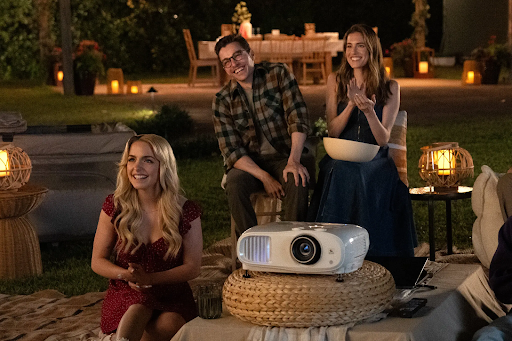
The movie centers around mother and wife Morgan Williams (played by Allison Williams) and her teenage daughter Clara (Mckenna Grace) as they navigate the death of husband and father Chris (Scott Eastwood) and sister and aunt Jenny (Willa Fitzgerald), dealing with betrayal and
loss along the way, confronting longkept secrets, exploring new relationships, and pushing the boundaries of their own relationship with each other.
“Regretting You” opens with teenage Morgan Williams, her boyfriend (and later husband) Chris, her sister Jenny, and her sister’s boyfriend Jonah (Dave Franco) as they prepare to go out for a night of partying.
While at the party, Morgan finds herself talking to Jonah, where she reveals that she’s pregnant with Chris’s child. Unbeknownst to Morgan, Jonah has been harboring a crush on her for years, and now his opportunity has been lost as they settle into their predetermined roles with partners who are all wrong for them.
Although the movie starts off relatively normally, the premise soon takes a weird turn as Morgan discovers her husband had been having an affair with her sister (who is now married to Jonah) before the car accident that killed the two.
The realization of this betrayal allows Morgan to begin exploring a relationship with her deceased sister’s husband, Jonah (Dave Franco), who has always loved her and vice versa. At the same time, Clara starts pursuing a relationship with the local stud Miller Adams (Mason Thames), to the dismay of her mother.
In an interesting turn of events, actors Grace and Thames are dating in real life, leading to a more engaging and realistic romance between the two characters. Even Williams and Franco are believable in their onscreen relationship, delivering a solid performance as long lost lovers.
Although Josh Boone was a remarkable director in “The Fault in Our Stars”, it’s apparent that he missed the mark with “Regretting You”, as the movie lacks overall depth, and the multiple ongoing storylines of each relationship leave much to be desired.
As the number of emotional scenes increases, they continue to feel less and less authentic, more like they are meeting a checklist.
Additionally, any comedic effect in “Regretting You” was purely coincidental, with awkward moments trying desperately to be solemn, and other scenes trying way too hard to be funny. It’s remarkable that the actors could even have performed some of the scenes present in the film with a straight face, because they’re so ridiculous and awkward that it’s hard to watch without cracking up.
Ultimately, while entertaining, the movie seems more suitable for a Hallmark special than for a 30-million-dollar production, falling flat on numerous accounts.