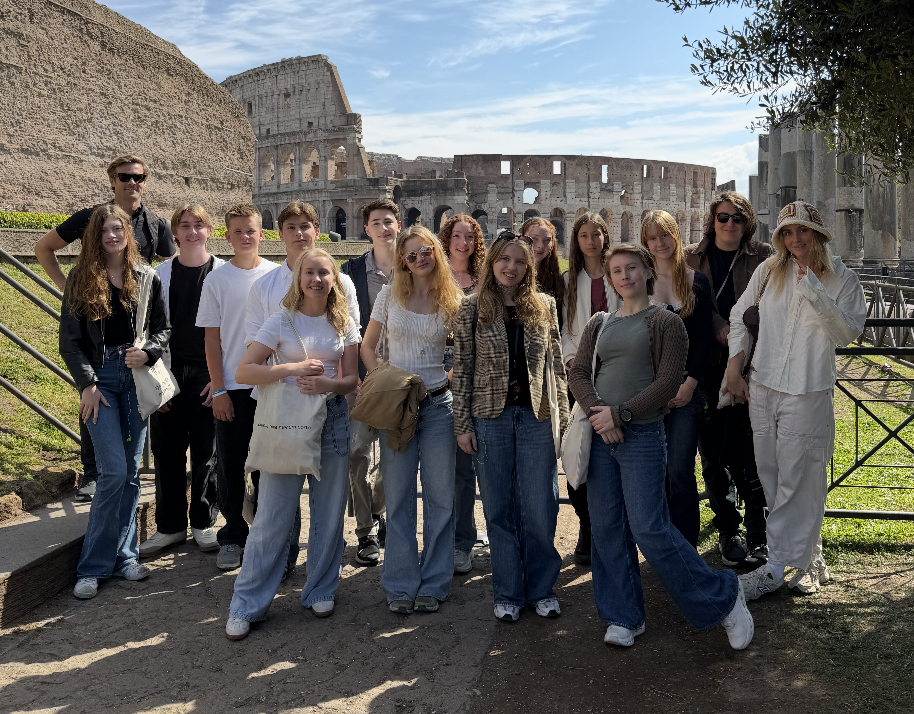















“Grazie!” students remarked, with beaming smiles and mouths stuffed with all-you-can-eat pasta and pizza. Led by middle school Latin teacher Duncan Briggs and upper school Latin teacher Angela Doermann, 14 high school Latin students had the pleasure of visiting Italy for seven days over Spring Break—the home of Renaissance art, ancient ruins, and rich history.
Through the Paideia Institute, Sam, their tour guide, navigated the students through the bustling country, greeting students with Paideia tote bags and packets containing famous Latin passages to translate. Starting in Rome and gradually making their way to Naples and Pompeii, students immersed themselves in classical culture and Italian cuisine every inch of the way—making this experience truly an unforgettable one.
“The purpose of this trip was to allow students to get a deeper understanding of the culture in Italy that we have been studying in the classroom for years, through experiencing it hands-on.” Latin instructor Angela Doermann said.
After the long and tiresome flight, students embarked on their first journey: the Roman Forum and Palatine Hill. Students translated Titius Livius’s tale of Romulus and Remus while taking in the breathtaking sight, learning that Romulus founded Italy on the Palatine Hill after a dispute with his brother, Remus, who favored the Aventine Hill. Students marveled at the different decorative patterns on the columns: the iconic egg-and-dart, bead-and-reel, dentil, and lesbian leaf.
Later that afternoon, students visited the Colosseum, a grand amphitheater where gladiator fights and animal hunts were notorious. Students learned about the sanguinary history that took place here, as thousands of innocent lives were lost tragically for the entertainment of others.
During free time, students traversed the Piazza del Popolo, buying countless items from Brandy Melville and subdued, and exploring stunning sights like the Trevi Fountain and Spanish Steps.
The group soon reconvened to visit the Ara Pacis, a symbol of peace commissioned by the Roman Senate to honor Emperor Augustus’s return from Spain to Gaul. Here, the group translated a poem from Ovid’s Metamorphoses, depicting Daphne’s transformation into a tree from Apollo’s perspective, as they saw the statue of Apollo and Daphne in the Galleria Borghese.
Aside from the magnificent sites, students also experienced cultural shocks that differ from the customs we see in America.
“What surprised me about the way people live in Europe is that they have these little water fountains that are called ‘big noses’ in Italian that have a giant spout coming out of a barrel that looks like a nose. It is completely fresh water that is safe to drink, but it surprised me how people just use those kinds of water fountains, even though it doesn’t look like it is fresh water.” Freshman Ella Osley said.
In the Vatican Museum, students were exposed to the Renaissance and Baroque works of Michelangelo, Raphael, Caravaggio, and Leonardo da Vinci, while simultaneously getting lost in the immense Greco-Roman sculptures.
After the group’s culmination in Rome, it was time for the next stop: Naples and Pompeii.
After seeing the catacombs, the group took a shuttle to Naples and visited the city’s Archaeological Museum, where each marble piece was seamlessly etched into the mosaics, each depicting different striking scenes. Sam introduced the group to three types of mosaics: opus vermiculatum (very small), opus tesselatum (medium), and opus sectile (larger pieces), each with a unique, distinct style.
Finally, the group immersed themselves in the baths of ancient Pompeii, seeing the caldarium, tepidarium, and frigidarium firsthand, and learned about the structure of Roman houses from the atrium to the horto.
Walking through the ruins of Pompeii, they saw Caecilius’s house—a figure that has shown up prominently in students’ Cambridge textbooks since middle school.
“I really loved seeing the ruins of Pompeii because it showed how much of a city they actually had, especially with the baths, and they are all intact and well preserved. It’s hard to believe that people were living on the same ground that we are now visiting years later.” Freshman Skye Johnson said.
For these kids, the Italy trip was more than just a journey; it was a step out of a textbook into a realm that transformed their view of the ancient world entirely.