
















According to the Center for Women’s Health, 25 years ago, 3.4% of global citizens were diagnosed with anorexia nervosa. Now, in 2026, the rate has tripled, now sitting at 9% — and that only covers those who are diagnosed (ANAD).
One little-known fact about anorexia is that it has the highest mortality rate of any psychiatric disorder, second only to substance use disorder, and Within Health says that about 20% of those who contract anorexia nervosa die within 20 years of being disordered — that’s one in five.
Why has this become so common? The answer is simple: the social media apps and websites we have grown to accept as normal.
Toxicity within disordered communities has always existed, and social media’s effect is negative; doing nothing but promoting and elevating the intense, life-or-death competition present between those afflicted with eating disorders.
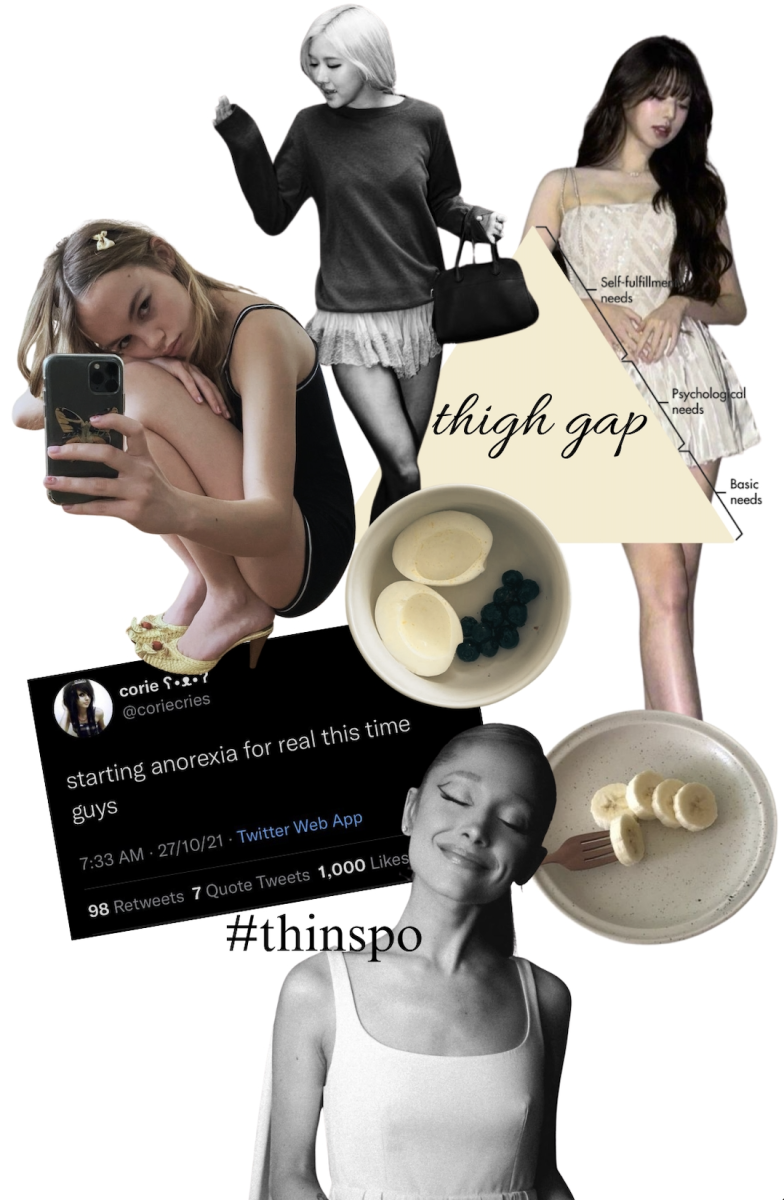
Twitter is the largest culprit of this — eating disorder Twitter, more commonly known as “edtwt,” a subspace dedicated primarily to weight loss and furthering disordered eating patterns, pushes young women to starve or purge themselves.
Jargon unique to these disordered communities is littered throughout eating disorder Twitter. The term thinspiration, commonly referred to as “thinspo,” is a label applied to images of petite if not emaciated women deemed the “ideal” body type. But the body inspiration does not stop there — “fatspo threads,” unethical and extraordinarily cruel collections containing images of overweight individuals simply existing in peace.
It’s undeniable — these collections push young women and teenagers to think that they aren’t enough and will not be enough until they lose enough weight to not only be sick, but physically “look” sick.
The agenda that individuals with eating disorders or disordered eating patterns must look a certain way — emaciated and sickly, typically — in order to be considered cause for concern continues pushing young women and teenagers to seek validation online.
However, according to Mayo Clinic, “about 35 percent of kids and teens who come in for a restrictive eating problem have a history of having been overweight or obese,” proving that the “anorexic body” that most accept as the standard for individuals with eating disorders isn’t the only face of disordered eating.
When most hear the word “anorexic,” an image of a too-skinny model is conjured up, and yet the National Association of Anorexia Nervosa and Associated Disorders says that, in reality, “fewer than 6% of people with eating disorders are medically diagnosed as ‘underweight.’ In fact, people [with] larger bodies are at the highest risk of [developing] an eating disorder in their lives.”
Social media has conflated sick and skinny into the same thing, pushing disordered individuals to think that they must look a certain way in order to be truly sick.
Additionally, romanticization is extremely common in these spaces. Being sick is labeled as something desirable, rather than profoundly miserable and debilitating.
Some say that spaces such as eating disorder Twitter and others like it are places of refuge for disordered individual. Not a place encouraging them to worsen their disordered eating, but rather a place letting them vent their frustrations.
However, the Eating Recovery Center says that “people spending over three hours daily on social media are twice as likely to develop eating disorders than those with less screen time.”
Yes, digital spaces can help struggling people find like-minded individuals, but disorders such as Anorexia Nervosa are extremely competitive, and constantly seeing smaller, thinner, and “sicker” people will have the inverse of the intended effect.
In a world where women’s bodies are considered equal to their beauty, deviating from the ideal body type can feel horrifying. Our worth is equated to our weight, so no wonder some women feel that they must reach a certain weight to be “enough.”
However, we cannot normalize the media’s sentiment that having protruding collarbones or a dangerously low body mass index is enviable and desirable.
Instead, we must remember that these girls and women are not “healthy” or “in good shape,” but rather incredibly weak and miserable.
Anorexia nervosa, bulimia nervosa, and various other eating disorders are just as serious as depressive disorders, and it is crucial to treat them as such so as to avoid normalizing them further.